
Winter Golf, Simulators, and the Reality of Improving Your Game
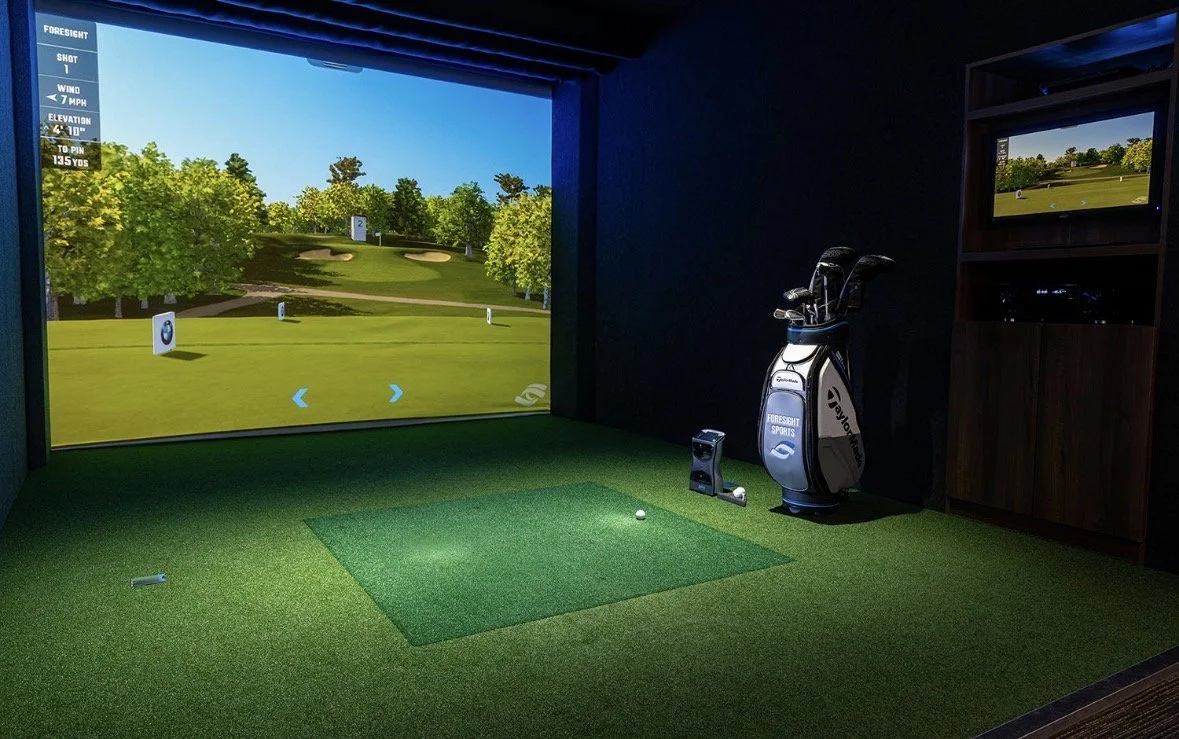
How indoor golf studios and launch monitor technology are changing winter practice in the UK, and why they can never fully replace the real game.
In Britain, winter has always been golf’s most honest season.The fairways are heavy, the greens slow, the wind unpredictable and the daylight short. Temporary tees appear, bunkers are sometimes taken out of play, and even a well-struck drive can plug into soft ground.
It is a very different game from the one we play in July.
For decades golfers simply accepted this reality. Winter meant fewer rounds, the occasional driving range session in the cold, and a quiet hope that the swing would still be there when spring returned.
But something has begun to change across the UK.
Indoor golf studios and simulator facilities are appearing everywhere from dedicated performance centres to small city studios. Much of this growth is driven by advanced launch monitor technology such as the TrackMan launch monitor, which measures ball flight and club delivery with remarkable precision.
For many golfers, winter practice has moved indoors.
The question is whether that actually improves the game.
The Challenge of Winter Golf in the UK
Golf in winter conditions can be frustrating even for experienced players.
Mud on the ball can destroy spin control. Soft turf can punish solid strikes. Slow greens make distance control difficult. Scores become inconsistent and often misleading.
Over time this has an effect that is rarely discussed.
Confidence begins to fade.
Golf is a game built on feedback. When a golfer repeatedly hits shots that produce unpredictable results, it becomes difficult to judge progress. Players start to feel that their swing is drifting rather than improving.
Motivation follows confidence.
And that is where many golfers lose momentum during the winter months.
Why Indoor Golf Has Grown So Quickly
Inside a simulator studio the environment is controlled. A golfer can practice without wind, rain, frozen turf or heavy ground conditions affecting the outcome of a shot.
More importantly, launch monitors provide detailed feedback on every strike:
Ball speed
Launch angle
Spin rate
Carry distance
Club path
For many golfers this is the first time they truly understand what their swing is producing.
Practice becomes measurable.
A golfer can work on a technical adjustment and immediately see whether it improves strike quality or ball flight. Distance gapping with irons and wedges can be measured with accuracy, and structured practice sessions become far easier to maintain.
But perhaps the biggest advantage is simply motivation.
Indoor golf turns practice into something enjoyable again.
Virtual rounds, closest-to-the-pin games and simulated courses introduce an element of competition and entertainment that keeps golfers engaged during the coldest months of the year.
And engagement is the key to improvement.
What Simulators Do Exceptionally Well
Used correctly, indoor practice environments are extremely effective in three areas.
1. Technical feedback
Launch monitors allow golfers to understand the relationship between swing mechanics and ball flight in a way that was once only available to elite players.
2. Repetition
A golfer can practise efficiently without environmental interruptions. This allows for focused technical work and faster learning.
3. Distance awareness
Understanding carry distances and gapping between clubs can dramatically improve scoring once the player returns to the course.
For golfers who take their practice seriously, these advantages can be substantial.
But it is important not to confuse training with the game itself.
What Simulators Can Never Replace
However advanced the technology becomes, indoor golf cannot fully replicate the realities of the course.
Uneven lies
Wind conditions
Firm or soft turf interaction
Visual depth and perception
The psychological pressure of a real scorecard
Practising from a mat does not perfectly replicate the interaction between club and turf. A slightly heavy strike might still produce an acceptable shot indoors, but outdoors that same swing could result in a weak approach falling short of the target.
More importantly, golf is not simply about technique.
It is a decision-making sport.
Standing on a tee with trouble on both sides, managing risk, and executing a shot under pressure are all elements that technology cannot fully simulate.
The simulator provides information.
The course provides reality.
The Smart Way to Use Winter Practice
Indoor golf works best when golfers treat it as preparation rather than replacement.
The winter months offer an opportunity to refine mechanics, improve strike consistency and develop a clearer understanding of distances. When spring arrives and the courses begin to firm up, those improvements can then be tested in real playing conditions.
In that sense, the simulator is simply a training ground.
The real test still takes place outdoors.
A Different Perspective on the Off-Season
For many golfers the most valuable benefit of indoor practice is psychological.
Winter no longer has to feel like lost time.
Golfers who remain connected to their game during the off-season often begin the new year with greater confidence and clarity. Their swing feels familiar, their distances are known, and their motivation remains intact.
The Greatmaker Perspective
At Greatmaker we believe the game has always rewarded a certain mindset.
Resilience…. Patience.
And the willingness to keep improving when conditions are far from perfect.
Indoor golf will never replace the experience of walking a course, but the opportunity to stay engaged with the process of improvement when the weather might otherwise push you away from the game.
And in golf, momentum matters.
Because the players who quietly keep working during winter are often the ones who arrive in spring ready to do one thing.
Raise their game.