
The Quiet Skill: How Golf Professionals Reach Unconscious Competence
Most golfers believe improvement comes from thinking more about their swing.
But at the highest level of golf, the opposite is true.
The best players perform when they stop thinking about mechanics altogether. Their swing happens instinctively, without conscious instruction. Psychologists call this state unconscious competence, when a skill has been trained so deeply that it becomes automatic.
For professional golfers, reaching this state is one of the most important and least understood elements of performance.
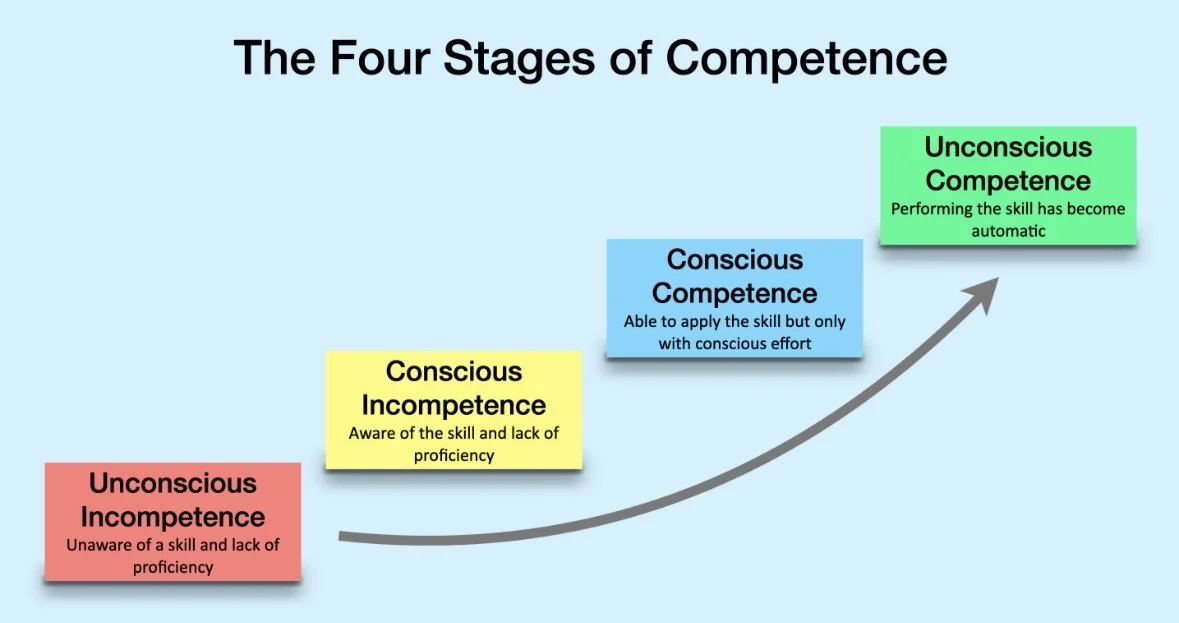
The Four Stages of Skill
Every golfer progresses through four stages when learning a skill.
1. Unconscious Incompetence
You don’t yet know what you’re doing wrong.
2. Conscious Incompetence
You begin to recognise mistakes but struggle to correct them.
3. Conscious Competence
You can perform the correct movement, but only with focused attention.
4. Unconscious Competence
The movement becomes automatic and instinctive.
Most amateur golfers live in stage three. Standing over the ball, they run through a list of swing thoughts, trying to control movements that should happen naturally.
But athletic performance rarely improves when it’s over-managed by the conscious mind.
Why Professionals Train for Automatic Performance
Elite golfers practise not just to improve technique, but to automate it.
Through thousands of repetitions, their brain builds reliable motor patterns that no longer require conscious control. This allows them to focus on what really matters during a round:
visualising the shot
reading the wind
selecting targets
maintaining rhythm and tempo
Instead of thinking about how to swing, they think about the shot they want to create.
The swing becomes a reaction rather than a calculation.
The Real Enemy of Good Golf: Overthinking
Golf uniquely invites overthinking. The pauses between shots create space for doubt, analysis, and mechanical interference.
Sports psychologists call this explicit monitoring — when the conscious brain tries to control movements that should remain automatic.
It’s why a swing that feels effortless on the range can suddenly feel tight when the scorecard matters.
Pressure doesn’t change the swing.
It changes how the brain tries to control it.
Protecting the Automatic Swing
Professional golfers develop habits that help protect unconscious performance.
A consistent pre-shot routine calms the mind.
An external focus keeps attention on the shot rather than mechanics.
And a commitment to trust the swing prevents last-second interference.
Just as important is emotional control. Bad shots are inevitable, but great players reset quickly and move forward.
The Real Goal of Improvement
Most golfers chase the perfect swing.
But the deeper goal of practice is something else entirely, building a swing that works without conscious control.
When preparation, repetition, and mindset come together, the game begins to feel different.
The swing becomes natural.
The mind becomes quieter.
Confidence replaces control.
This is the quiet skill professional golfers spend years developing.
The ability to trust their game when it matters most.
Raise Your Game.