
Golf’s Next Generation: Why experience Still Wins in Golf
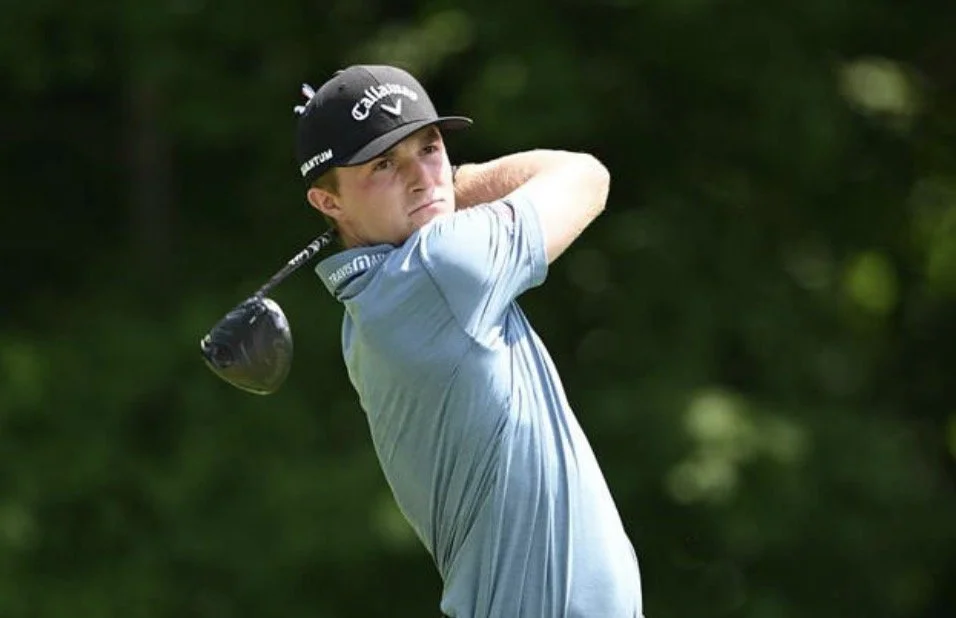
Blades Brown is coming. So are Luke Clanton, Aldrich Potgieter, Michael Thorbjornsen and a new generation of golfers who have grown up believing they belong on the biggest stage.
But there is an uncomfortable truth for every young player chasing the next level:
Talent gets you there. Experience keeps you there. Resilience is what ultimately separates the great from the almost-great.
That is one of the reasons we created Greatmaker.
Built Through Pressure.
Because golf doesn’t care how talented you are when the putt is worth a championship.
The game is getting younger. But winning is still about experience.
The narrative around professional golf has changed.
The next generation is arriving earlier, hitting the ball further and becoming professional before most people have finished university.
Blades Brown is a perfect example.
Brown turned professional at just 17 and chose to bypass college golf. Now 19, he has already shown that he belongs on the PGA TOUR. In 2026 he has recorded a third place, two further top-10 finishes and six top-25s across his PGA TOUR starts. [PGA Tour](https://www.pgatour.com/player/66417/blades-brown/results?deviceId=918748c6-9a9b-4e53-bd17-7412b5d2fa80&utm_source=chatgpt.com)
That’s extraordinary.
But it is also the beginning of the story — not the end.
Because winning one tournament, contending in a major and surviving the final nine holes when everything is on the line are completely different tests.
And that is where experience becomes an asset.
Look at the major champions and challenge the assumption
It would be easy to say that golf is now dominated by older players.
But we need to be precise.
The 2026 men’s majors were won by Rory McIlroy, Aaron Rai, Wyndham Clark and Ryan Fox. [Golf](https://golf.com/news/winners-losers-major-championship-season-rory-scottie-bryson/?utm_source=chatgpt.com)
So it isn’t accurate to claim that all major winners are now in their late 30s and 40s.
More interestingly elite golf is proving that experience has not become obsolete.
Rory’s second Masters victory came after years of near misses, pressure, expectation and learning how to handle Augusta National.
Ryan Fox won The Open at 39.
And the wider professional game continues to demonstrate just how long elite players can remain competitive.
Justin Rose is now 46 and remains firmly inside the world’s best players. He has won six of his 13 PGA TOUR titles during the last decade and continues to compete because he believes he can still perform at the highest level. [Reuters](https://www.reuters.com/sports/golf/defending-st-jude-champ-justin-rose-46-still-pushing-stay-elite--flm-2026-08-11/?utm_source=chatgpt.com)
Meanwhile, the 2025 season produced another remarkable pattern: Rory McIlroy completed the career Grand Slam, Scottie Scheffler added two majors, 35-year-old J.J. Spaun won the U.S. Open and 34-year-old Tommy Fleetwood won the TOUR Championship. PGA TOUR analysis noted that only one player aged 26 or younger finished inside the year-end world top 25. [PGA Tour](https://www.pgatour.com/article/news/latest/2026/01/02/twenty-six-players-under-26-to-watch-for-in-2026-young-stars-rising-talent-new-year-rookies-paul-hodowanic?utm_source=chatgpt.com)
That’s the real story.
Young players are arriving faster. But experience is still incredibly difficult to manufacture.
So who is coming through?
There is no shortage of talent.
Blades Brown — the wildcard
He has already demonstrated that his game can translate to professional golf, and his decision to turn professional at 17 tells you something about his mentality.
But Greatmaker’s question isn’t:
“How good is Blades Brown?”
We already know he’s good.
The question is:
“What happens when the game stops going his way?”
That is the test every young golfer eventually faces.
A missed cut.
A swing that disappears.
A final-round lead.
A four-footer for a million dollars.
A major championship where the entire world is watching.
That is where resilience becomes performance.
Luke Clanton — serious potential
Luke Clanton is another name that demands attention.
PGA TOUR analysis identified him as one of the leading young players to watch in 2026, highlighting his ball-striking while noting areas of his game that still need development. [PGA Tour](https://www.pgatour.com/article/news/latest/2026/01/02/twenty-six-players-under-26-to-watch-for-in-2026-young-stars-rising-talent-new-year-rookies-paul-hodowanic?utm_source=chatgpt.com)
That is precisely what makes his journey interesting.
The objective isn’t to become brilliant at 22.
It’s to keep improving until 27, 30, 35 and beyond.
Aldrich Potgieter — raw power, enormous ceiling
Potgieter is already a TOUR winner and was the 2025 PGA TOUR Rookie of the Year. He led the TOUR in driving distance that season and has the physical tools to overwhelm golf courses. [PGA Tour](https://www.pgatour.com/article/news/latest/2026/01/02/twenty-six-players-under-26-to-watch-for-in-2026-young-stars-rising-talent-new-year-rookies-paul-hodowanic?utm_source=chatgpt.com)
But even his coach has described an element of “rawness” in his game.
And that’s the point.
Raw talent is the starting line.
The great players learn how to turn that talent into something dependable under pressure.
Michael Thorbjornsen
Thorbjornsen is another name worth watching.
His ball-striking profile is already elite, and PGA TOUR analysis highlighted his ability off the tee and with his approach play. [PGA Tour](https://www.pgatour.com/article/news/latest/2026/01/02/twenty-six-players-under-26-to-watch-for-in-2026-young-stars-rising-talent-new-year-rookies-paul-hodowanic?utm_source=chatgpt.com)
The question now is whether he can convert potential into sustained performance.
That’s a completely different skill.
The rookie paradox
Young golfers have something veterans don’t.
Fearlessness!
They haven’t experienced the disappointment of losing a tournament they should have won.
They haven’t stood over a six-foot putt knowing that millions of people are watching.
They haven’t spent ten years wondering whether their best golf is behind them.
But veterans have something different.
Perspective!
They know that one bad hole isn’t the end.
They know that a tournament can turn in 30 minutes.
They know how their body reacts under pressure.
They know how to prepare.
They know when to attack.
And, perhaps most importantly, they know how to lose.
That knowledge has to be earned.
This is where Greatmaker begins.
Greatmaker isn’t built around the idea that everyone has to become a professional golfer.
It’s built around something much more.
It exposes your preparation.
Your discipline.
Your decision-making.
Your confidence.
Your ability to respond after failure.
That’s why our philosophy is:-
Built through pressure
Not protected from pressure.
Not perfect under pressure.
Because every setback is part of the process.
Every missed putt teaches you something.
Every failure gives you another opportunity to build resilience in golf and life.
Every time you stand back up, you become harder to break.
The next generation will be incredible
Don’t misunderstand the message.
We aren’t betting against the rookies.
Quite the opposite.
We want to watch them come through.
Blades Brown has already shown flashes of something special.
Luke Clanton has the game.
Aldrich Potgieter has extraordinary physical tools.
Michael Thorbjornsen has the statistical profile.
And there are more coming.
The PGA TOUR itself identified 26 players under 26 to watch entering 2026 a clear indication that the next generation is already knocking loudly on the door. (PGA Tour)
Some will become stars.
Some will win tournaments.
A handful may win majors.
But the ones who ultimately build extraordinary careers won’t simply be the players with the best swings.
They’ll be the players who learn how to handle everything that comes with having one.
Because golf doesn’t test your swing forever
Eventually, everyone can hit the ball.
Everyone can practise.
Everyone can become technically better.
The separator becomes psychological.
Can you execute when you’re tired?
Can you recover after a double bogey?
Can you stay patient when the leaderboard moves against you?
Can you perform when the outcome matters?
Can you come back after failure?
That is residence
It’s something you build
That greatness is earned….
Through the early mornings.
The bad rounds.
The missed cuts.
The setbacks.
The doubt.
The pressure.
And the decision to keep going anyway.
That’s Greatmaker.
Raise your game - because the game will test you.